Table of Contents
ToggleYour office walls are about 400 square feet of untapped potential. Whether you’re working from a spare bedroom, a home office nook, or a dedicated studio, what you surround yourself with every day shapes focus, mood, and productivity. Office wall decor doesn’t have to mean sterile corporate art or slapped-on gallery prints. Done right, it’s a strategic blend of visual interest, functionality, and personal style that makes you actually want to sit down and work. This guide walks you through nine practical decor approaches, from paint techniques and floating shelves to living walls, that’ll transform your workspace from “I tolerate this” into “I love working here.”
Key Takeaways
- Strategic office wall decor combines visual interest, functionality, and personal style to boost focus, mood, and productivity in your workspace.
- Typographic art and motivational prints should be hung at eye level (57–60 inches from the floor) in quality frames with UV-protective glass to prevent fading and reduce screen glare.
- Floating shelves require secure stud mounting with proper fasteners and should distribute weight toward the back; mix décor intentionally with a focal point per shelf to avoid cluttered displays.
- Accent walls painted in colors like soft sage green, deep blue, or warm gray create professional impact—test paint swatches in multiple lighting conditions before committing to a full wall.
- Living walls and plants improve air quality and reduce stress; start with wall-mounted shelves holding low-light tolerant species like pothos, or choose low-maintenance preserved botanicals if frequent watering isn’t feasible.
- Gallery walls gain impact through cohesive framing, consistent spacing (1.5–2 inches between frames), and a template method to avoid misaligned holes before hanging.
Inspiring Art and Prints for Professional Spaces
Art on your walls isn’t decoration, it’s your visual anchor for focus and motivation. The key is choosing pieces that don’t distract but instead reinforce why you’re working.
Motivational Quotes and Typography
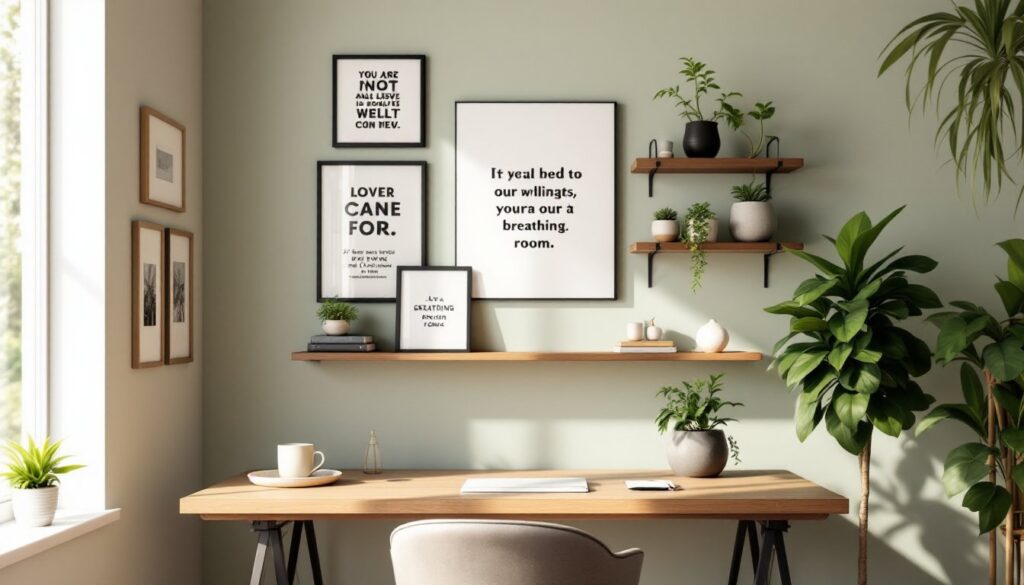
Typographic art works especially well in offices because it’s functional and inspiring. A 24″ × 36″ canvas print with a quote you genuinely live by beats generic posters every time. Avoid overly trendy fonts: clean, readable sans-serif or a well-designed serif does the job without aging in six months.
When hanging type-focused work, measure twice. The center of the print should land at eye level when you’re seated at your desk, roughly 57–60 inches from the floor. If you’re hanging a gallery of smaller prints (8″ × 10″ or 11″ × 14″), center them around the same axis.
Consider frame style carefully. Floating frames (where the print appears suspended behind glass) work in modern spaces: thin metal frames suit minimalist setups: wood frames warm up industrial or cottage-style offices. Cheaper frames often have cheap glass, consider upgrading to UV-protective, non-glare glass if the wall gets direct sunlight: it prevents fading and reduces screen glare that bounces back at you.
You don’t need to buy expensive art to get professional results. High-quality printable designs from stock sites (often under $10) can be printed locally on quality paper, then framed affordably. Digital downloads also let you swap out pieces seasonally without racking up frame costs.
Floating Shelves and Functional Wall Storage
Floating shelves kill two birds: they’re decor and storage rolled into one, freeing up desk surface for actual work. A wall with floating shelves says “intentional” faster than blank drywall.
Before you install, find the studs. Use a stud finder (electronic models under $20 work fine) and mark them with a pencil. Floating shelves need 3/4-inch lumber mounted into studs with 1/2-inch lag bolts or screws rated for your wall type. Drywall alone can’t hold shelves, weight goes into the studs. Most floating shelves max out at 25–35 lbs. depending on span and fastener quality: distribute weight toward the back (closer to the wall) to minimize sagging.
For a 36-inch shelf, secure into at least two studs. Recessed brackets (hidden inside the shelf) look cleaner than surface-mounted ones. Material matters: solid wood (walnut, oak, pine) feels warmer: steel or aluminum brackets suit industrial or tech-forward offices.
Styling is where function meets aesthetics. Avoid the Instagram look of five identical white boxes and a succulent. Instead, mix: a 3-ring binder holding current projects, a small ceramic or concrete planter with a hardy plant (pothos, snake plant), a framed 5″ × 7″ print, and 1–2 inches of breathing room. The key is visual hierarchy, one focal point per shelf, the rest supporting it.
If you’re renting and can’t drill into studs, adhesive-backed shelves (rated for 10–15 lbs.) work for lightweight decor only, books and heavy objects will fail. Better option: lean a 24-inch lean-to shelf against the wall and secure the top to avoid tipping. Or use wall-mounted tension rods with lightweight woven baskets for a flexible, temporary solution.
Accent Walls and Paint Techniques
A single accent wall, painted a deeper, richer tone than the other three, draws focus without overwhelming the space. Choose the wall behind your desk or the one you face most while working.
Before painting, prep is non-negotiable. Patch all nail holes and imperfections with spackling compound. Sand lightly with 120-grit sandpaper once it’s dry. Dust thoroughly (a tack cloth is worth the dollar). Prime any dark stains or previous dark colors with primer-sealer: primer reduces the number of paint coats needed and prevents bleed-through.
Paint quality matters. Budget paint (under $20/gallon) often needs three coats and covers poorly: mid-range paint ($25–35/gallon) typically requires two coats and lasts longer. For an 8′ × 10′ wall, plan on 1.5 gallons. Use eggshell or satin finish, flatter finishes hide imperfections but mark easily in a working office.
Color psychology is real. Soft sage green and warm gray encourage calm focus: deep blue and charcoal add gravitas without feeling oppressive: warm terracotta or rust energize without being jarring. Test swatches on the actual wall in natural and artificial light before committing. Colors shift dramatically in different lighting, what looks perfect at noon might feel muddy at 3 p.m.
For something beyond a solid color, consider geometric stenciling (requires painter’s tape and steady hands), color blocking (horizontal or vertical stripes in complementary tones), or a matte finish with metallic trim along the top edge. These techniques are achievable without a professional if you’re patient with prep and application. Start with a small test area: you can always repaint.
Gallery Walls and Photo Displays
A gallery wall clusters art, photos, and objects into a cohesive, curated display. It’s less formal than single large prints and allows personal storytelling, photos of places you’ve worked, inspiration shots, and objects meaningful to your practice.
Layout first, before hanging anything. Lay all pieces on the floor in the configuration you want. Aim for a cohesive frame style (all wood, all black metal, or mixed metals) and consistent spacing (1.5–2 inches between frames is standard). The overall grid should be centered on the wall, with the center of the grouping at eye level when seated.
To avoid crooked holes, use a template method: cut kraft paper to the shape of each frame, tape it to the wall, mark the nail holes through the paper, then hang. Alternatively, photograph your floor layout, print it to scale, tape it to the wall, and mark holes through the printout. It takes 15 minutes and saves the “why is this frame tilted” regret.
Framing photos or inspirational images keeps a gallery wall looking intentional. Avoid mismatched frames and chintzy glass. 8″ × 10″ prints in 10″ × 12″ mats and black frames create visual consistency: you can swap prints without re-framing. For a mixed gallery, limit yourself to 2–3 frame styles to avoid visual chaos.
Want to update without rehashing nails? Consider picture hanging ledges, narrow shelves that support frames without glass, allowing quick swaps. They’re especially useful if you rotate seasonal inspiration or client work into the display. These ledges hang just like shelves and can hold 10–15 lbs. each depending on fastener quality.
Natural Elements and Living Wall Decor
Plants on your walls do more than look good, they improve air quality, reduce stress, and signal that you care about your environment. Living walls are low-key biophilia, and they work in offices.
Vertical plant systems range from simple (a mounted wooden planter box holding succulents) to elaborate (a modular living wall frame with irrigation). Start simple. A wall-mounted shelf holding 2–3 6-inch potted plants (pothos, philodendron, ZZ plant) requires minimal maintenance and looks polished. Plants prefer filtered light: if your office has low light, choose low-light tolerant species like pothos or cast iron plant. Water on a schedule, not when you remember, most office plants suffer from overwatering, not drought.
For a more dramatic look, living wall panels (moss walls or hydroponic systems) are available from specialty retailers. Moss walls are static (no watering, just occasional misting) and work well where live plants won’t thrive due to light or humidity. They cost $200–500 for a 2′ × 3′ section but create instant impact and don’t require maintenance.
If walls aren’t an option, tall plant stands in the corner or beside a window achieve the same biophilic effect and work in rentals. Pair plants with natural wood shelving or a woven wall hanging to reinforce the organic aesthetic.
One caution: plants attract dust and occasional pests if neglected. Commit to a watering schedule before installing. Underwatered plants drop leaves and look sadder than no plants at all. If you travel frequently or forget to water, choose dried pampas grass, bleached branches, or preserved botanicals, they deliver the natural-element vibe without the responsibility. Popular sites like Homedit and Addicted 2 Decorating feature seasonal living wall inspiration if you need visual references. Research plant varieties on Decoist to find species suited to your light conditions before buying.
Consider how plants interact with your desk organizing ideas, a plant beside your monitor softens the screen’s edge, while shelves above your desk can hold trailing pothos or small botanicals without cluttering work surface.
Conclusion
Your office walls are a reflection of how you work and what matters to you. Whether you paint an accent wall, hang a gallery of meaningful images, install floating shelves, or surround yourself with plants, the goal is the same: create a space where productivity and pride coexist. Start with one or two changes. Let them breathe. Then add the next layer. A room that evolves over time feels authentic, not sterile. Your future self will thank you every time you sit down to work.